Hazardous Tree Removal in Centerton, AR
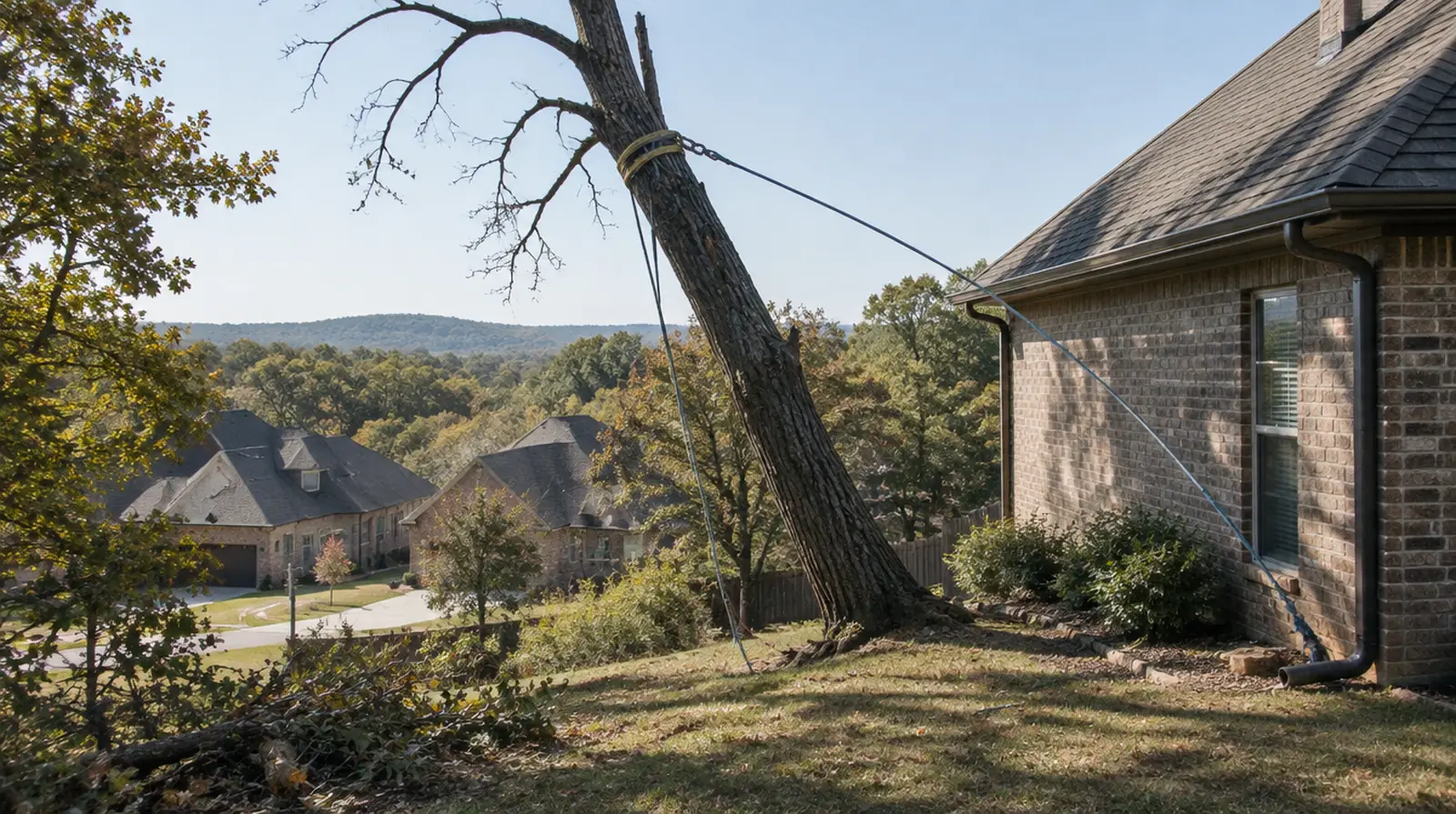
Standing risk trees — leaning toward the house, cracked leaders, dead wood over a play area — taken down on purpose before they pick their own day.
Talk to a real person: (479) 929-2785Get a free estimate
Tell us what the tree is doing and where it sits. We answer every message the same day.
- Licensed
- Insured
- Free estimates
- Emergency response
Hazardous removal is not the same as an emergency call
If a tree is already on the house, hanging over the drive after a storm, or blocking the road, that is emergency tree service — after-hours urgency, photos for insurance, get people out of the rooms under it. Hazardous tree removal is the planned job that happens before that night: a standing tree that still looks mostly upright but is clearly a risk to people or property, scheduled on a normal workday with the right rigging and a flat price.
It is also narrower than general tree removal. Plenty of removals are unwanted or dead trees with no urgent target underneath. Hazard work is about the tree that leans into the roof line, the cracked leader over the swing set, the dead ash hanging over the neighbor’s fence, or the post oak with a heaving root plate aimed at the driveway. The goal is to take the risk out on your schedule, not the storm’s.
Risk signs we take seriously in Centerton
A lean that is getting worse. Shallow limestone means shallow root plates. Fresh soil cracking or heaving on the side opposite the lean means the plate is failing. That tree is not going to settle back down, and waiting for the next wet spell is gambling with whatever sits in the fall line.
Cracked or co-dominant leaders. A visible split running down from a fork, or two nearly equal stems with bark pinched between them, can fail without a full storm. Sometimes cabling and bracing can support sound wood. When the wood is already decayed or the crack is opening, removal is the safer plan.
Dead or brittle wood over a target. Untreated ash that emerald ash borer has finished with goes brittle fast. Dead tops on post oaks after grade changes around new houses do the same. A dead limb over a play area, sidewalk, or parked cars is a hazard even if the rest of the tree still leafs out.
Overhang into roofs, lines, and tight lots. Newer Centerton subdivisions put houses close together. A tree that would be a simple drop on open acreage becomes a rigging job when the only landing zone is a narrow side yard, a pool, or the neighbor’s shed.
How we take a hazard tree down on a tight lot
We start by mapping targets: house, vehicles, fences, play equipment, utility drops, and the neighbor’s property line. If there is room to drop sections into a clear zone, we do that. If there is not, we climb or set the bucket and rope pieces down so nothing free-falls onto what you are trying to protect.
On soft ground after rain we put plywood or mats under the chipper and truck so the yard is not a rutted mess. Brush gets chipped, wood is cut to the lengths you want or hauled off, and we rake and blow the drive and street before we leave. The stump can stay for now or we can grind it the same day — that part is priced separately so you are not paying for work you do not want.
When we will tell you not to remove it yet
Not every scary-looking tree is a hazard removal. Some need weight taken off and a few more good years. Some need support hardware instead of a saw. Some are already mid-failure and belong on an emergency call, not a scheduled ticket. We would rather walk you through that on site than sell you a takedown you did not need — or delay one that should not wait another season.
What affects the price
- Size and species. A tall brittle ash costs different time than a smaller ornamental that still has flex.
- Targets underneath. House, pool, fences, and power drops drive how much has to be rigged instead of dropped.
- Access. Front-yard truck reach is cheaper than a locked backyard with no side-gate path for the chipper.
- Condition. Wood that is already cracked or hollow takes more care — and more time — than a sound trunk.
Most planned hazard removals in town fall in a similar band to other removals once size and access are known. Estimates are free, we look at it in person, and the number we give you is flat. If the tree fails before the scheduled day, call us and we switch to the emergency path.
Get a flat price on a hazard tree
Call (479) 929-2785 and we will come look at the lean, the targets, and the access — usually within a day or two. Nothing owed for the visit.