Tree Disease Treatment in Centerton, AR
Figure out what is killing the tree, treat it if there is still a chance, and skip the spray when the tree is already past saving.
Talk to a real person: (479) 929-2785Get a free estimate
Tell us what the tree is doing and where it sits. We answer every message the same day.
- Licensed
- Insured
- Free estimates
- Emergency response
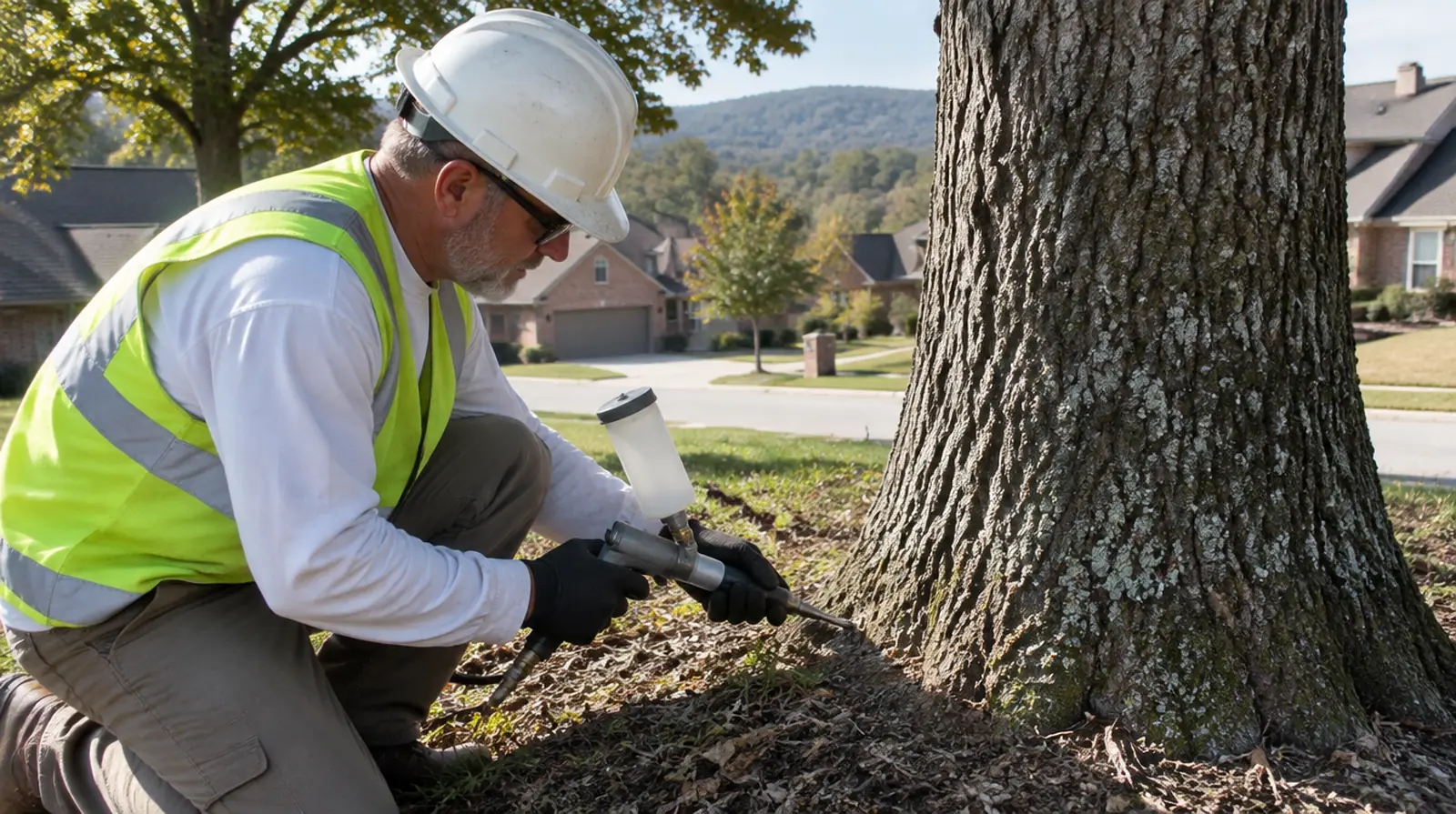
What tree disease treatment involves
It starts with figuring out what is actually wrong. Half the trees people in Centerton think are diseased are suffering from compacted soil, buried root flares after a builder changed the grade, drought stress on shallow limestone, or construction damage instead. We look at the pattern of damage, which part of the canopy is affected, the timing, the species, and what the neighboring trees are doing.
Once we know what we are dealing with, options may include a trunk injection, a soil-applied systemic, timed foliar work, pruning out infected wood, or fixing the growing conditions. Serious insect and fungal problems usually need more than one visit across a season, and we tell you the schedule up front instead of selling a one-time spray that cannot finish the job.
Signs a tree is sick rather than just old
Watch for a thinning canopy where you can see more sky through the tree each year, dieback that starts at the top and works down, and leaves that come out small, pale, or yellow between green veins. Early leaf drop in July or August is a signal, and so is a sudden wilt where whole branches brown out in days while the leaves stay attached.
On evergreens, needles dropping from the inside and the bottom up is a classic fungal pattern. Check the trunk for oozing, cracked or blistered bark, small exit holes, sawdust at the base, and any shelf fungus on the root flare. A post oak that has been dying from the top for several years after grade changes around a new house is often a stress story, not a sprayable disease — and we will say so.
What is actually hurting trees in Northwest Arkansas
Emerald ash borer has moved through Benton County and the broader Fayetteville and Springdale area. Untreated ash trees are failing, and dead ash goes brittle faster than almost anything else we cut. Trunk injection can hold a tree when enough canopy is still alive, but it has to be repeated on a schedule for the life of the tree. Once the upper canopy is bare, treatment will not bring it back — that is a removal conversation, not a treatment cycle.
Oak wilt is a real hireable concern for red oak groups in the broader region. It moves through beetles attracted to fresh cuts and, in some situations, through connected roots. That is why oak pruning timing matters: cutting oaks during beetle flight season can invite infection. We will talk through timing before we schedule sanitation or structural pruning on oaks.
Other problems we see on Centerton and Bentonville lots include anthracnose after a cool, wet spring on sycamore and maple, needle-cast patterns on spruce planted too close together, and stress decline on woodland oaks left standing when a subdivision went in and the grade changed around them. Not every thin canopy needs a chemical — sometimes the honest fix is pruning, mulching correctly, or accepting that the tree is past the point where treatment pays.
Treat it, or take it down?
Treatment makes sense when enough of the tree is still alive to respond and the tree is worth the ongoing cost. A large shade tree over a patio that took forty years to grow is usually worth evaluating. A small untreated ash in the back corner of the lot, already half dead, usually is not. The rough line on ash is canopy: above about half alive, injection has a real chance; below that you are paying to slow down something that has already happened.
When a tree is past treatment, taking it down before it goes brittle is cheaper and safer than waiting another season. When disease has weakened a fork but the wood is still sound, support options like cabling and bracing can sometimes buy time after the health issue is under control. We do not invent miracle cures, and we will not sell you treatments on a tree that needs to come out.
What affects the cost
- Trunk size. Dose and labor scale with diameter, so a large tree costs more to treat than a small one for the same problem.
- Method. A soil application is usually less involved than a trunk injection that needs equipment and training.
- Schedule. Some problems need one visit; others need follow-ups across the growing season.
- Access and species. Tight lots, height, and how many trees share the same problem all show up in the quote.
Estimates are free. We look at the tree in person and tell you whether treatment, pruning, monitoring, or removal is the right next step — not a menu of products first.
Get a free look at a sick tree
Call (479) 929-2785 and we will come diagnose it, usually within a day or two. Nothing owed for the visit.