Tree Cabling and Bracing in Centerton, AR
Steel support for a weak fork or a heavy limb on a tree you would rather keep than cut down.
Talk to a real person: (479) 929-2785Get a free estimate
Tell us what the tree is doing and where it sits. We answer every message the same day.
- Licensed
- Insured
- Free estimates
- Emergency response
What tree cabling and bracing actually does
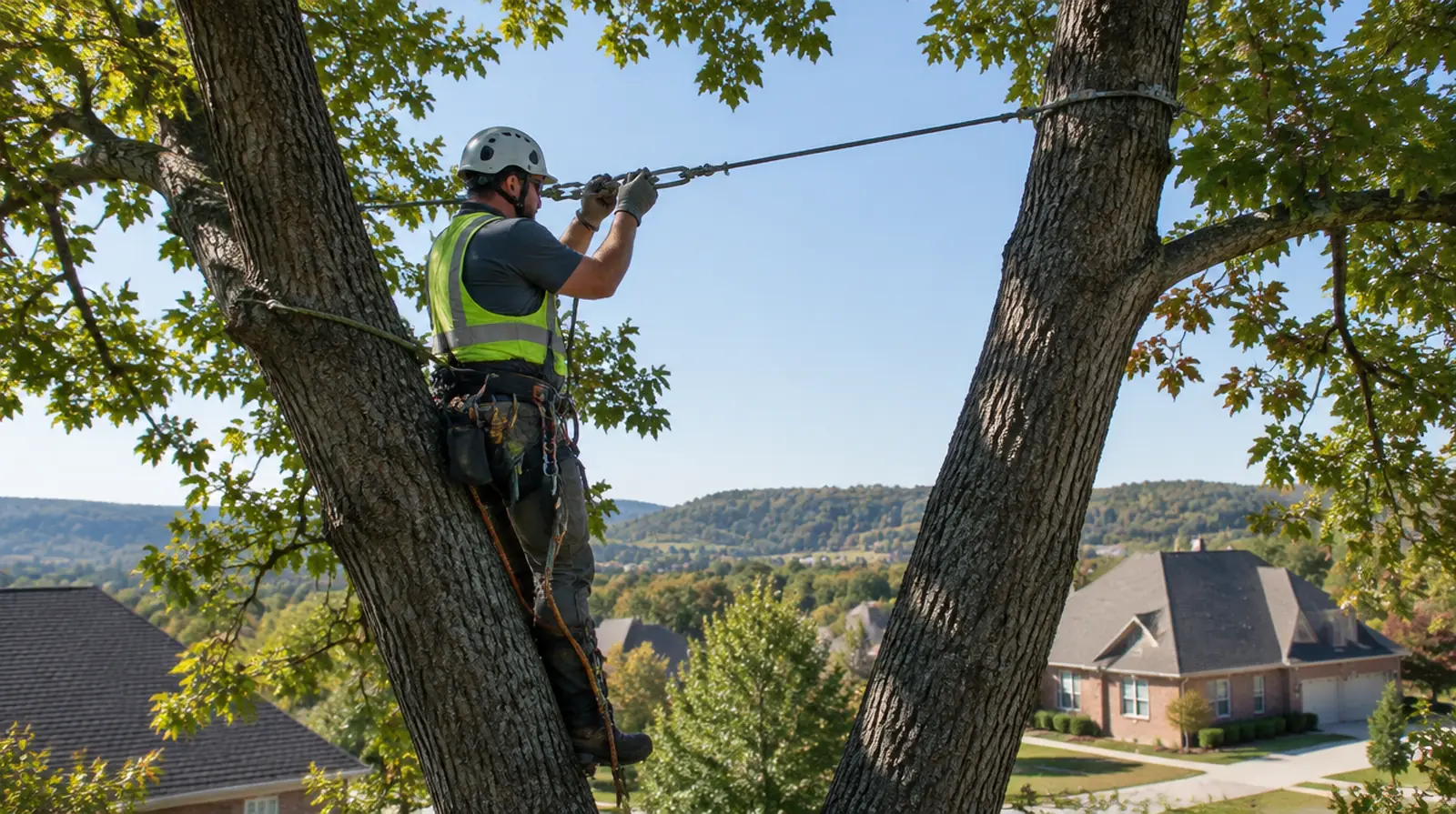
Cabling and bracing is the installation of steel support hardware in a tree on a Centerton property so a weak fork or a heavy limb is less likely to tear apart in wind, ice, or wet snow. It is for homeowners with a large, otherwise healthy tree they do not want to lose. Done right, it lowers the chance of a split and buys years out of a tree that would otherwise have to come down.
Cabling means running a steel cable high in the canopy between two limbs, roughly two-thirds of the way up from the defect, anchored into the wood with through-bolts or lag hardware. The cable stays slightly slack in normal weather and limits how far the limbs can swing apart in a storm. Bracing is different: threaded steel rods installed straight through the trunk at or just above a split, holding the two halves together against the forces trying to open them. Bad forks often get both — rods at the union and a cable overhead.
When a Centerton tree is a candidate for support
Look at the main fork. If the trunk splits into two nearly equal stems with a narrow V between them and a seam of bark pinched inside, that union is weak and will eventually fail. Other signs are a visible crack running down from the fork, one side of the tree moving differently from the other in the wind, or a long horizontal limb over the house, driveway, or play area that you would rather support than cut off.
Cabling is worth considering when the tree is otherwise sound, when it is large enough to matter for shade or property value, and when it stands where failure would damage something. Bradford pears and ornamental pears planted across Northwest Arkansas subdivisions in the eighties and nineties are classic candidates — those tight V crotches fail in ice storms. Mature oaks and maples with included bark at a co-dominant stem show up on older lots near the middle of town the same way.
Support is not a substitute for pruning. In many cases taking weight off the ends of the limbs does most of the work and the cable handles the rest. We will tell you which combination your tree needs.
Why weak unions form on trees here
It usually starts when the tree is young. A sapling that loses its central leader, or one that is never structurally pruned, grows two competing stems instead of one trunk. As both thicken, the bark between them is squeezed rather than joined by wood fiber, and the union ends up glued together rather than grown together. Fast-growing species are the usual suspects — ornamental pear, silver maple, river birch, and some of the pin oaks left standing when subdivisions went in around Centerton and Bentonville.
Decades later, a wet snow load or a straight-line wind finds the flaw. The shallow limestone soils around here also mean root plates can shift after a wet spell, which adds leverage on an already weak fork. Hardware does not fix a failing root plate; it only addresses the aerial defect.
Support it or take it down?
Hardware supports sound wood. It does not fix rot. If the union is already decayed, if the trunk is hollow, or if the tree has significant dieback in the crown, bolting it together just creates a heavier hazard, and removal is the safer call. If a limb has already failed or is hanging after a storm, that is not a cabling job — that is emergency tree service.
We will look at the fork in person and tell you whether the tree is worth supporting, whether pruning alone is enough, or whether the honest answer is to take it down before it fails on its own schedule.
What affects the price
- How many cables and rods. A single cable between two leaders is the simplest install.
- Height and access. Hardware goes high in the canopy, which takes time to set correctly on a tall oak or maple.
- Pruning done with it. Most cabling jobs include taking weight off the ends of the limbs first.
- Follow-up inspections. Hardware should be checked every few years as the tree grows around the anchors.
Estimates are free. The number we give you is flat for the work we scope. If we find decay we did not expect once we are in the canopy, we stop and talk to you before we install hardware that would only make things worse.
Get an honest read on your fork
Call (479) 929-2785 and we will come look at the tree, usually within a day or two. Nothing owed for the visit.